Can Ceramic Cookware Be Used on Induction Stoves?

Time:2026-09-21 Author:Charlotte
0%

Can ceramic cookware be used on induction stoves? The answer is conditional. Ceramic itself is not magnetic, so a fully ceramic pot usually will not activate an induction burner. However, many ceramic-coated pans contain an iron or stainless-steel induction base beneath the coating. That hidden layer makes the difference.

The U.S. Department of Energy reports that induction cooking can transfer about 85% of its energy to cookware, compared with roughly 32% for gas and 75% to 80% for conventional electric resistance cooking. These figures explain why induction feels unusually quick. A small saucepan can heat water rapidly, while the surrounding glass surface stays comparatively cooler. Still, efficiency depends on cookware compatibility, pan size, and contact with the burner.

Consumer Reports appliance expert Paul Hope offers a practical test: “If a magnet sticks firmly to the bottom, the cookware should work on induction.” That guidance is useful, but it is not a complete guarantee. The manufacturer’s symbol and product instructions deserve attention. Some pans attract a magnet yet heat unevenly. Others may have a slightly warped base after repeated use.

Look at the underside, not only the glossy ceramic coating. Place a refrigerator magnet against the base before cooking. If it slides off, the pan will not heat directly on most induction stoves. An induction-compatible adapter plate may help, but it can reduce speed and energy performance. The answer is simple only after the base is checked.
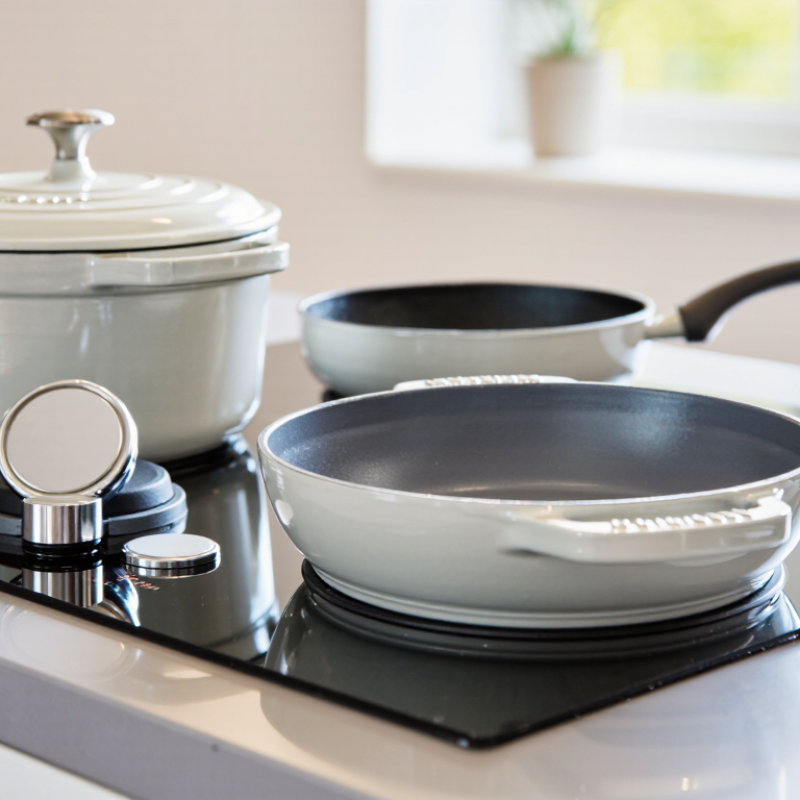
Can Ceramic Cookware Be Used on Induction Stoves?

How Induction Works at 20–50 kHz: The Role of Ferromagnetic Cookware Bases

Can Ceramic Cookware Be Used on Induction Stoves?

Ceramic cookware can work on induction, but ceramic alone cannot create heat. Induction stoves generate alternating magnetic fields, commonly between 20 and 50 kHz. These fields pass through the ceramic surface and reach the pan’s ferromagnetic base. The base then develops eddy currents and microscopic magnetic losses. Heat appears inside the metal, not mainly beneath it.

A simple magnet test helps. If a magnet grips the underside firmly, the cookware may be compatible. A weak grip deserves caution. The base should also be flat, thick, and fully attached. Gaps can cause uneven heating, buzzing, or poor temperature control. I have found that a pan may boil water quickly in the center while its ceramic walls remain noticeably cooler. That detail is easy to miss.

The U.S. Department of Energy’s Energy Saver guidance reports approximately 85% energy-transfer efficiency for induction cooking. Conventional smooth-top electric cooking reaches about 75–80%. These figures explain induction’s speed, although results depend on pan size, base construction, and household voltage. The International Electrotechnical Commission’s IEC 60335-2-6 standard also addresses safety requirements for household cooking appliances. Compatibility labels are useful, but they are not perfect evidence. A magnet, a level base, and a short water test provide better practical confirmation.

Why Standard Ceramic Cookware Usually Fails Without a Magnetic Metal Layer

Ceramic cookware is not automatically induction-compatible. The ceramic body contains no magnetic metal, so an induction hob cannot create the heat needed for cooking. Induction works through a magnetic field that excites a ferromagnetic base beneath the pan. Without that layer, the surface may stay cool, even when the cooking zone is visibly active.

A simple test helps: place a magnet against the pan’s underside. If it does not hold firmly, standard induction cooking will usually fail.

This limitation affects efficiency, not just convenience. The U.S. Department of Energy reports that induction cooking can be up to 10% more efficient than smooth-top electric cooking and up to three times more efficient than gas. However, those figures assume compatible cookware.

A ceramic pan with a thin magnetic plate may work, but performance can vary with plate thickness, flatness, and heat distribution. The pan may heat slowly or create a hot ring in the center. That is easy to miss.

Safety guidance in IEC 60335-2-6 also emphasizes cookware suitability for household cooking appliances, rather than appearance alone. In practice, check the manufacturer’s induction symbol, test the base with a magnet, and inspect for a completely flat underside. Ceramic cookware is attractive, but appearance proves very little.

Induction-Ready Ceramic: Testing for Ferromagnetic Bases and Even Contact

Can Ceramic Cookware Be Used on Induction Stoves?

Ceramic cookware can work on induction stoves, but ceramic itself does not create heat. The pan needs a ferromagnetic base, usually made with magnetic-grade iron or steel. A simple magnet test offers a useful first check. Hold a magnet against the outside bottom. Strong attraction suggests compatibility, but it does not prove reliable performance.

The base must also sit evenly on the glass surface. A warped bottom can produce weak heating, buzzing, or uneven cooking. Place the cool pan on the cooktop and check for rocking. Then compare its base diameter with the induction heating zone. A narrow magnetic disk may heat slowly, even when the pan is technically induction-ready. Keep the contact area clean and dry.

My practical check is imperfect. A magnet cannot measure the base’s thickness or magnetic response under heat. Manufacturer specifications remain more dependable. If testing an unfamiliar pan, use a small amount of water on low power. Watch for steady heating across the base rather than one sharply boiling spot. Ceramic coatings may also hide scratches, dents, or a slightly raised center. That detail is easy to miss.

Magnet-Test Method: A Practical Check for Induction Compatibility

Ceramic cookware can work on an induction stove, but the word “ceramic” is not enough. Many pans have a ceramic coating over aluminum, which usually does not respond to induction. Solid ceramic cookware also needs a magnetic metal layer to heat properly. The base matters more than the cooking surface.

Try a simple magnet test before cooking. Place a strong magnet against the outside bottom of the pan. Test the center, then move it around the edges. A firm pull suggests that the base contains magnetic material. A weak pull may produce uneven heating. No attraction usually means the pan will not activate the induction burner.

Check the magnet itself.

I have found this test useful in my own kitchen, especially with older pans that lack clear markings. However, it is not perfect. A magnet can stick to a thin layer while the pan still heats slowly. Some bases also have uneven magnetic coverage. After testing, place the pan on the induction surface and use a low setting briefly. Watch whether the burner detects it and whether the base warms evenly. Keep the pan flat and dry. Curved or damaged bottoms can reduce contact and cause poor performance. The manufacturer’s care instructions remain important, because magnetism alone cannot confirm safe temperature limits or oven compatibility.

The magnet test is a practical screening method for induction compatibility. A strong magnetic response usually indicates that the cookware base contains ferromagnetic material and may work on an induction stove. Pure ceramic, glass, aluminum, and copper generally show no magnetic attraction unless they include a magnetic induction plate. Stainless steel performance varies by grade, so test the actual base.

Energy Benchmarks: Induction Transfers About 85% of Heat to Cookware

Can Ceramic Cookware Be Used on Induction Stoves?

Ceramic cookware can work on an induction stove, but ceramic alone does not create induction heat. The pan needs a magnetic metal base beneath its ceramic surface. Hold a small magnet against the underside. If it sticks firmly, the pan may be compatible. Still, check its cooking instructions, because magnet tests are not perfect.

Induction transfers about 85% of its heat to the cookware. That is a strong efficiency benchmark compared with many traditional cooking methods. Heat begins in the pan’s magnetic base, not around the pan. This can make boiling water faster and reduce wasted heat in the kitchen. The ceramic coating may also spread heat gently, although uneven construction can create hot spots. I once assumed every ceramic pan was induction-ready. That assumption was too simple.

Tips: Use a flat-bottomed pan for steady contact. Start with medium heat, then adjust slowly. Avoid sliding the pan, since rough particles can scratch the glass surface. Listen for unusual buzzing and stop if the base vibrates. Let the pan cool before washing it. A magnet is useful, but the manufacturer’s specifications remain more reliable. Even with efficient heating, results depend on pan thickness, food quantity, and stove settings. Five minutes can feel different.

Can Ceramic Cookware Be Used on Induction Stoves? - Energy Benchmarks: Induction Transfers About 85% of Heat to Cookware

Practical comparison of ceramic cookware constructions and their suitability for induction cooking.
Cookware Construction Induction Compatibility Typical Heat-Transfer Path Approximate Induction Efficiency Expected Heating Response Recommended Check
Ceramic-coated metal pan with a magnetic base Yes Induction field heats the ferromagnetic base; heat then spreads through the metal body and ceramic coating. About 80–90%; approximately 85% is a commonly cited benchmark for induction cooking. Fast, with relatively precise power control. Confirm the induction symbol or test the underside with a magnet.
Enameled cast iron with a magnetic core Yes The magnetic iron heats directly, while the enamel surface transfers heat to the food. About 75–85%, depending on pan size, fit, and cookware thickness. Slower to preheat but retains heat well. Use moderate power and avoid sliding the pan across the glass surface.
Solid ceramic cookware without a metal base No Ceramic is not ferromagnetic, so it does not directly respond to the induction field. Not directly measurable on a standard induction hob. The cooktop may not detect or heat the vessel. Use gas, electric, or another heat source specified by the cookware instructions.
Ceramic-coated aluminum without a magnetic disk Usually no Aluminum is electrically conductive but not sufficiently ferromagnetic for direct induction heating. Not directly compatible with most induction hobs. Little or no heating unless an induction adapter is used. Look for a bonded magnetic plate on the underside.
Ceramic-coated stainless steel with a magnetic base Yes The magnetic stainless-steel layer absorbs the induction energy and conducts heat to the cooking surface. About 80–90% under suitable operating conditions. Fast and generally even when the base is thick and flat. Ensure the base is flat and covers the active cooking zone adequately.
Key Energy Benchmarks
  • Induction cooktops commonly transfer about 85% of the input energy to the cookware, although actual performance varies with pan size, base design, cookware alignment, and power level.
  • Ceramic refers to the cooking surface or coating; induction compatibility depends mainly on whether the cookware contains a suitable ferromagnetic base.
  • A magnet should stick firmly to the base for a quick compatibility check, but the cookware instructions remain the final reference.

FAQS

Can ceramic cookware work on an induction stove?

Yes, but ceramic alone cannot generate induction heat. The cookware needs a ferromagnetic base beneath the ceramic layer. That base usually contains magnetic-grade iron or steel.

How does induction heat the pan?

The cooktop creates an alternating magnetic field, commonly between 20 and 50 kHz. The field passes through the ceramic surface and reaches the metal base. Eddy currents and magnetic losses then produce heat inside the metal.

What is the quickest compatibility test?

Hold a magnet against the pan’s outside bottom. A strong grip suggests possible induction compatibility. A weak grip requires caution. This test is useful, not conclusive.

Why can a magnetic pan still perform poorly?

The base may be too thin, warped, narrow, or poorly attached. Gaps can create buzzing and uneven heating. A small magnetic disk may heat slowly despite technical compatibility.

How can I check whether the pan sits correctly?

Place the cool pan on the clean, dry cooking surface. Check whether it rocks or leaves visible gaps. The base should remain flat and contact the heating zone evenly. Flat contact matters.

What should I observe during a water test?

Add a small amount of water and use low power. Watch whether heating spreads steadily across the base. A sharply boiling center may indicate uneven heat distribution. The ceramic walls may remain noticeably cooler.

Is induction cooking more energy-efficient?

Induction transfers approximately 85% of energy to the cookware. Smooth electric cooking commonly reaches about 75–80%. Actual results depend on pan size, base design, and household voltage. Numbers can vary.

Can compatibility labels be trusted completely?

Labels provide helpful information, but they are not perfect proof. Specifications from the cookware maker are more dependable. A magnet, level-base check, and water test offer practical confirmation. My testing method remains imperfect.

Conclusion

Can ceramic cookware be used on induction stoves? The answer depends on its base rather than its ceramic surface. Induction technology creates a rapidly alternating magnetic field, typically operating around 20–50 kHz, which generates heat directly in ferromagnetic cookware. Standard ceramic cookware usually lacks magnetic metal and therefore will not heat effectively on an induction cooktop. However, ceramic-coated or ceramic-bodied cookware designed with a ferromagnetic base may be induction-ready.

A simple magnet test can help determine compatibility: place a magnet against the underside of the pan. If it attracts firmly, the cookware may work, provided the base is flat and makes even contact with the cooking surface. Always check for a clear induction-compatible marking when available. Induction can transfer roughly 85% of its heating energy to the cookware, making it efficient, but this benefit applies only when the pan contains a suitable magnetic layer and sits evenly on the stove.

Charlotte

Charlotte

Charlotte is a seasoned marketing professional with a deep understanding of the company's portfolio and a passion for elevating its presence in the market. With a keen eye for detail and a commitment to excellence, she ensures that our professional blog is regularly updated with insightful articles......