Choosing cookware sounds simple until a shiny pan heats unevenly or a heavy pot strains your wrist. The question “what features should you look for in cookware” deserves more than a material checklist. Your stove, cooking habits, cleaning routine, and budget all matter. A small stainless-steel saucepan may suit daily oatmeal, while a wide skillet needs steady heat and a comfortable handle. Little details count.
Food writer and culinary television host Alton Brown is known for his kitchen-tool rule: “The only unitasker allowed in my kitchen is a fire extinguisher.” It is a useful reminder to consider versatility, not just appearance. Still, one pan cannot do everything well. Stainless steel handles browning and acidic sauces; cast iron holds heat but asks for more care. Nonstick makes eggs easier, though its coating and heat limits deserve attention. There are trade-offs. Always.
This guide looks at practical features: material, weight, construction, handle design, lid fit, heat compatibility, and upkeep. It also considers how cookware performs across different cooking tasks, rather than treating one popular material as the universal winner. A thick base can help prevent scorching, but it does not guarantee even heating on every burner. That part is easy to overlook. No single “best” set fits every kitchen, and recommendations can miss the mark when they ignore the cook’s real routine. Use these points to compare options, then choose pieces you will genuinely use.
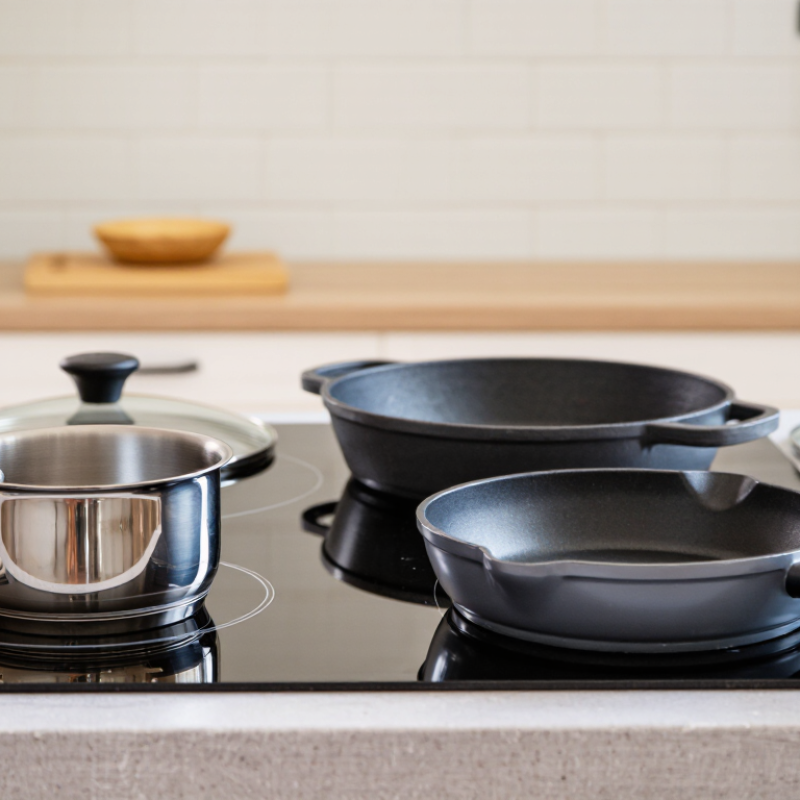
Choosing cookware begins with what you actually cook, not a long list of features. A skillet used for eggs and quick vegetables needs responsive heat and a comfortable handle. A pot for soup needs enough depth and a lid that sits securely. If you often move food from stovetop to oven, check the temperature limits for every component, including the handle. These details matter more than owning a matching set. That matters.
Your burner type changes how a pan heats. On induction, cookware must have a magnetic base; a simple magnet test can help confirm compatibility. Gas flames may extend around a small pan, so choose a base that sits steadily over the grate. Electric coils can heat unevenly, especially when a pan is much wider than the burner. Flat-bottomed cookware generally makes better contact on smooth cooktops. Still, no pan fixes an unstable or mismatched burner.
Think about your usual batch size, too. A crowded skillet traps steam, so vegetables may soften instead of browning. A very large pan can be awkward to lift when nearly empty. Estimate portions you cook on an ordinary weeknight, then compare that amount with the pan’s usable cooking surface. Small batches behave differently. This is not an exact formula: cooking habits shift, and a pan that works for dinner may feel too small when guests arrive. If possible, handle cookware in person and consider its weight when full.
At 20°C, copper conducts heat at about 401 W/m·K, aluminum at 237, and steel at 16. That gap matters. In cookware, higher conductivity can move burner heat across the base and toward the rim more quickly. A thin aluminum pan may respond quickly when heat changes; steel can leave hotter areas near the burner. Useful, but not the whole story.
These figures describe materials, not finished pans. Alloys, thickness, and bonded layers change how cookware performs. An aluminum or copper core can spread heat beneath a stainless-steel cooking surface, even though steel itself conducts relatively poorly. A quick-response pan can help with delicate sauces, but it may also punish a distracted cook. I would not choose by conductivity alone; that shortcut misses weight, durability, and how evenly the pan contacts the burner. A thick base may soften temperature swings, yet take longer to heat. The numbers are a starting point, not a promise.
Copper and aluminum conduct heat much faster than steel. Values are approximate; conductivity varies by alloy and steel grade. Cookware performance also depends on thickness and construction.
Cladding determines how evenly heat travels from the burner into the cooking surface. Look at the exposed rim: continuous layers should appear bonded, without gaps, loose edges, or uneven thickness. Material data explain why the layers matter. The Copper Development Association reports copper conductivity near 400 W/m·K, while aluminum alloys are commonly near 200; ASM Handbook data place austenitic stainless steel around 15 at room temperature. These are approximate material values, not a promise of pan performance. That matters.
Check the base on a cool, flat counter. Press opposite edges gently and watch for rocking, then use a straightedge to spot obvious gaps. A small gap can affect contact on a glass cooktop, though visual checks are imperfect. Some bases also change shape as they heat. Not always obvious.
Read the manufacturer’s thickness statement carefully. Total body thickness is not the same as the thickness of each cladding layer. Ask whether the figure describes the base, sidewalls, or a specific metal layer, and whether it is measured in millimeters or gauge. ASTM A240/A240M specifies requirements for stainless-steel sheet and strip, but a cookware listing may not state how its thickness was measured. I would not treat a single thickness number as proof of quality; construction details and a stable, even base deserve equal attention.
A coated pan should come with clear information about its food-contact coating. Check the product details for a statement referencing FDA 21 CFR 175.300. This regulation covers certain resinous and polymeric coatings under specified conditions of use. A reference is useful, but it is not a promise that every cooking method or temperature is suitable. Read the stated limits.
Care instructions matter just as much. Note the maximum heat setting, whether the pan is oven-safe, and whether it can go in a dishwasher. A coating made for gentle stovetop cooking may not suit a hot broiler. Small print counts.
At home, use the recommended utensils and cleaning method. If the instructions call for handwashing, a soft sponge and mild detergent can help reduce wear. Avoid heating an empty pan unless its directions allow it. That detail is easy to miss. Coatings can scratch or deteriorate, so stop using a pan if its surface is visibly damaged. Keep the care guide; I would not rely on memory alone.
Before buying, check the oven rating for the whole pan, not just its body. A glass lid, silicone grip, or plastic knob may have a lower heat limit. Look for a clear maximum temperature in the care guide. If the rating is missing, do not assume the cookware is oven-safe. ASTM F2179-20 covers thermal-shock testing for glass cooking ware, a useful reminder that sudden temperature changes matter. Avoid moving a cold glass lid straight into a hot oven.
Handle design matters in daily use. A long, firmly attached handle gives better control, but it can stick out over a burner or feel awkward in a small oven. Hold the pan if possible; check its balance when empty and imagine lifting it full. Small detail, big difference. Lid fit also deserves a practical test: a lid should sit steadily and limit splatter, but a loose lid can rattle or let steam escape. A perfect seal is not always desirable for ordinary simmering.
Cleaning claims need context. The FDA Food Code (2022) specifies a 180°F final rinse for certain commercial high-temperature dishwashers; that is not a requirement for home machines, but it shows why heat tolerance matters. Check whether the handle, coating, and lid are dishwasher-safe separately. ASTM F2179-20’s thermal-shock focus also supports avoiding abrupt hot-to-cold changes during cleanup. I still find care labels easy to overlook. Read them before the first wash.
| Feature | What to Check | Useful Buying Guidance | Why It Matters |
|---|---|---|---|
| Oven rating | Confirm the maximum oven temperature for the pan and, separately, for its lid and any removable parts. | Choose a rating that meets or exceeds the highest temperature in your recipes. The lowest-rated component sets the safe limit for the assembled cookware. | A pan may tolerate more heat than its lid, knob, coating, or handle. Ratings vary by product, so check the care instructions. |
| Handle material and shape | Look for a secure attachment, a comfortable grip, enough clearance from the burner, and a helper handle on heavier pans. | For frequent oven use, check that the handle is oven-safe at your intended temperature. Assume metal handles can become hot; use an oven mitt. | Handle design affects control when lifting or pouring. Heat-resistant materials do not guarantee a handle will stay cool on the stovetop. |
| Lid fit and construction | Check that the lid sits securely and that the knob, rim, and lid material are suitable for your cooking method and oven temperature. | A close-fitting lid helps retain heat and moisture. If you need to monitor food, a glass lid can be useful; follow its temperature and care limits. | Lids can have different oven limits from their pans. Sudden temperature changes may damage some glass lids. |
| Cleaning requirements | Read the care instructions for the cooking surface, exterior, handle, and lid. Check whether dishwasher use is permitted. | Stainless steel often tolerates scrubbing better than nonstick coatings. Nonstick surfaces generally need nonabrasive tools; seasoned cast iron needs drying and periodic oiling. | The right choice depends on how much upkeep you are willing to do. Dishwasher suitability varies by cookware and can affect its finish or seasoning. |
| Weight and balance | Lift the pan with one hand if possible, and consider its weight when full. Check whether the handle feels balanced and stable. | Choose a lighter pan for frequent lifting; heavier cookware may suit slow, steady cooking if you can handle it comfortably. | A full pan is substantially heavier than an empty one, and a helper handle can make lifting safer. |
| Cooktop compatibility | Check the cookware instructions for your cooktop type. Induction requires a magnetic base. | For induction, test the base with a magnet: if it sticks firmly, the cookware is likely compatible, but the product instructions are the final guide. | Cookware that is not compatible with a cooktop may heat poorly or not work at all. |
Tip: Check the cookware’s specific use and care instructions before buying or using it; temperature limits and cleaning guidance vary by product.
Match the pan to the task. A skillet suits eggs and quick vegetables; a deep pot works better for soup. A matching set is not essential.
Hold a magnet against its base. If it sticks, the pan may be induction-compatible. Check the product details too; the magnet test is not a complete guarantee.
Compare its usable cooking surface with your usual portions. Crowded vegetables can steam instead of browning. Small batches vary, and dinner for guests may need more room.
Place it on a cool, flat counter and gently press opposite edges. If it rocks, its base may be uneven. This quick check has limits.
Inspect the exposed rim for bonded, continuous layers. Avoid visible gaps, loose edges, or uneven thickness. A neat rim helps, but does not prove even heating.
No. Check whether the figure refers to the base, sidewalls, or a particular layer. I would not trust one number alone.
Look for clear food-contact coating information and stated heat limits. Check whether it is oven-safe or dishwasher-safe. Small print counts.
Follow its care guide, use recommended utensils, and clean it as directed. Avoid heating it empty unless the instructions allow it. If the surface is visibly damaged, stop using it. I still find that detail easy to miss.
Choosing cookware starts with understanding how you cook. Consider your usual tasks, the type of burner you use, and the size of the meals you prepare. These factors help determine the pan shape, capacity, and construction that will suit your kitchen. When deciding what features should you look for in cookware, compare how materials conduct heat: at 20°C, copper conducts at about 401 W/m·K, aluminum at 237, and steel at 16. These figures offer a useful comparison, but the cookware’s overall construction also matters.
Inspect the cladding, check that the base sits flat, and review the manufacturer’s stated thickness. For coated pans, look for relevant food-contact information, including reference to FDA 21 CFR 175.300, and follow the care instructions. Finally, make sure the oven rating fits your cooking habits, the handles feel practical and secure, and the lid fits well. Consider how much cleaning each piece requires before choosing cookware for everyday use.

Eartha Cookware