Choosing what cookware works on induction cooktops from China requires more than checking a product label. Induction technology creates heat through a magnetic field, so the cookware must contain magnetic material. Stainless steel with a magnetic base, cast iron, and carbon steel usually perform well. Aluminum, copper, glass, and ceramic pans need an added ferromagnetic layer.
Lisa McManus, executive tasting and testing editor at America’s Test Kitchen, explains that “a magnet is a quick way to check whether cookware works on induction.” This practical test helps buyers inspect Chinese-made pans before purchase. Place a small magnet against the pan’s underside. A firm attraction suggests compatibility. A weak pull deserves caution.
Look closely at the base.
A flat, stable bottom matters. It should sit evenly on the cooking zone, without wobbling or visible gaps. Thick, layered bases can distribute heat better, while very thin metal may create hot spots. Some Chinese cookware manufacturers provide induction symbols, magnetic test results, and material specifications. Reliable suppliers should also identify the steel grade and base construction clearly.
Still, labels can be incomplete. I once treated an “induction-ready” claim as sufficient, but the pan heated unevenly during a simple simmer test. That mistake changed my checking process. Compatibility is only the beginning. This guide examines what cookware works on induction cooktops, including Chinese stainless steel pans, cast iron skillets, carbon steel woks, and cookware with bonded magnetic plates. It also considers handle safety, flatness, durability, food-contact quality, and everyday performance.
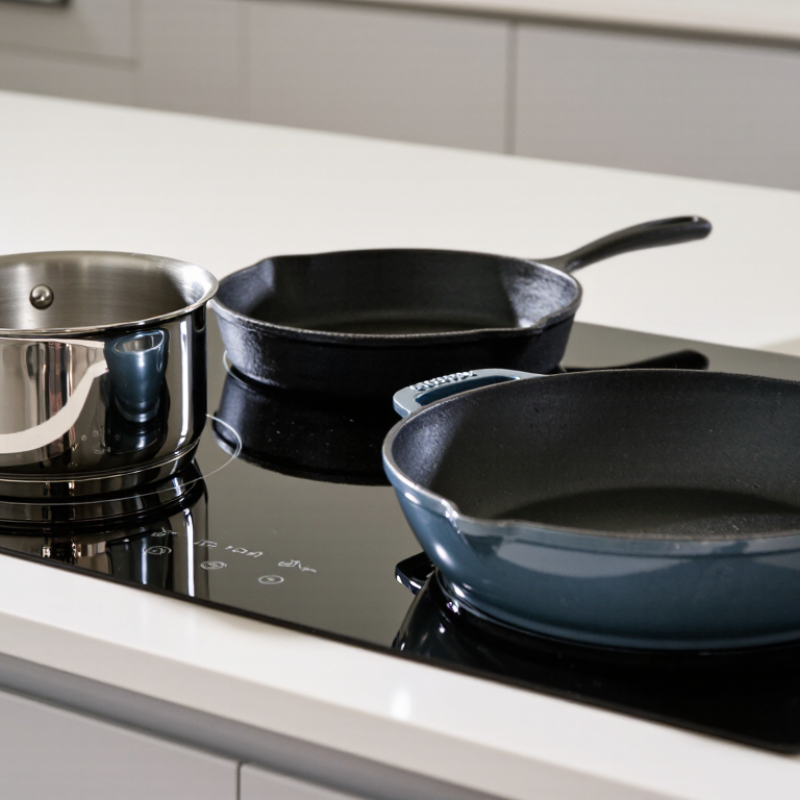
Cookware for induction cooking must satisfy one basic requirement: its base needs magnetic metal. Cast iron, carbon steel, and many stainless-steel pans usually qualify. Aluminum, copper, glass, and ceramic cookware normally do not work without a magnetic plate.
A magnet test is practical. Place one under the pan. If it grips firmly, the cookware may operate. That test helps. Not always. Stainless steel grades differ, so suppliers should confirm the exact alloy and induction rating. A flat base also matters. Warped cookware can heat unevenly, make noise, or lose contact with the cooking zone. The pan base should match the zone diameter closely. A very small base may activate poorly.
The U.S. Department of Energy’s Energy Saver guidance reports roughly 85% heat-transfer efficiency for induction cooking, compared with about 75–80% for conventional electric cooking and 32% for gas. These figures explain why the base must transfer magnetic energy efficiently. IEC 60335-2-9 also emphasizes safe construction, stable contact, and suitable materials for household cooking appliances. When sourcing cookware from China, request magnetic-permeability testing, base-flatness measurements, and heat-cycle results. Ask for samples, not only certificates. A five-minute magnet check cannot reveal long-term warping. That is an easy mistake. Multi-layer cookware may perform well, but its magnetic layer must remain continuous and close to the cooking surface.
| Cookware Material or Construction | Induction Compatibility | Why It Works or Does Not Work | Recommended Base Characteristics | Practical Checks Before Use | Typical Advantages |
|---|---|---|---|---|---|
| Cast iron | Generally compatible | Cast iron is ferromagnetic, so the induction field can generate heat directly in the pan. | Flat, smooth base; a fully flat base is preferable for stable contact and even heating. | Use a magnet on the cooking surface and confirm that the pan sits level without rocking. | Strong heat retention and high-temperature cooking performance. |
| Carbon steel | Generally compatible | Carbon steel contains enough iron to respond to the magnetic field produced by an induction cooktop. | Flat magnetic base with no significant warping. | Test the base with a magnet; season the surface according to the cookware instructions. | Fast response, relatively light weight, and suitability for searing. |
| Magnetic stainless steel | Usually compatible | Stainless steel cookware works when its alloy or attached base is sufficiently magnetic. | Magnetic stainless-steel body or a bonded ferromagnetic base. | Check the induction symbol or use a magnet on the exterior bottom; a weak attraction may indicate limited compatibility. | Corrosion resistance, easy cleaning, and broad everyday use. |
| Non-magnetic stainless steel | Compatible only with a magnetic base | Some stainless-steel alloys are not sufficiently magnetic and will not heat directly unless a magnetic layer is bonded to the bottom. | Encapsulated or bonded ferromagnetic disk covering most of the base. | Test the bottom with a magnet rather than relying only on the word “stainless steel.” | May provide stainless-steel durability while retaining induction compatibility. |
| Enameled cast iron | Generally compatible | The cast-iron core is magnetic; the enamel coating does not prevent induction heating. | Flat, undamaged base with intact enamel around the cooking surface. | Inspect for chips or exposed rough areas that could scratch the glass cooktop. | Heat retention, durable enamel interior, and compatibility with many cooking methods. |
| Aluminum | Not compatible by itself | Aluminum is not ferromagnetic, so it cannot normally receive heat directly from an induction field. | Requires a firmly bonded magnetic stainless-steel or iron base designed for induction. | Look for an induction designation and confirm magnetic attraction at the exterior base. | Lightweight construction and good thermal conductivity when paired with a suitable magnetic base. |
| Copper | Not compatible by itself | Copper is highly conductive but not ferromagnetic, so a plain copper pan will not normally activate induction heating. | Requires a bonded ferromagnetic plate or magnetic stainless-steel bottom. | Check the actual bottom material; copper-colored exterior surfaces do not prove induction compatibility. | Excellent thermal conductivity when manufactured with an appropriate induction base. |
| Glass, ceramic, or stoneware | Not compatible by itself | These materials are non-magnetic and do not couple with the induction field. | Requires a manufacturer-integrated magnetic plate specifically intended for induction use. | Use only when the cookware is explicitly marked for induction and the base is approved for direct cooktop contact. | Non-reactive cooking surfaces and, depending on construction, attractive presentation. |
| Induction adapter plate | Can enable some non-magnetic cookware | The magnetic plate is heated by induction and transfers heat to cookware placed above it. | Flat, compatible diameter and a heat-resistant handle or lifting method. | Confirm that the cooktop instructions allow adapter plates; use lower settings to reduce overheating risk. | Allows selected aluminum, copper, glass, or ceramic cookware to be used indirectly. |
| Round-bottom wok or warped pan | Limited or unsuitable | Induction cooktops work best when the magnetic base is close to the glass surface. A curved or warped base may heat unevenly or fail to be detected. | Use a flat-bottom version with a stable magnetic contact area. | Check for rocking, visible gaps, and an unstable position before heating. | Flat-bottom cookware offers more reliable detection and more even energy transfer. |
| Small cookware below the cooktop’s detection range | May not be detected | Induction zones have a minimum effective vessel size; a very small magnetic base may not activate the zone. | Base diameter should meet the minimum size specified in the cooktop manual. | Check the cookware diameter against the selected cooking zone requirements. | Correct sizing improves activation reliability and reduces unused magnetic-field area. |
Cast iron, carbon steel, and magnetic stainless steel usually work. Aluminum, copper, glass, and ordinary ceramic usually need a magnetic layer.
Place a small magnet against the pan’s outside bottom. A firm attachment suggests compatibility, but it is not complete proof.
Check that the base is flat, smooth, clean, and free from visible warping. A curved base may heat slowly or cause power changes.
Add two cups of water to the pan. Use medium power and observe steady heating within a few minutes.
Repeated stopping, error messages, buzzing, or boiling in one small area can indicate poor construction. Uneven boiling deserves attention.
No. Some pans pass the magnet test but heat slowly because their magnetic layer is too thin. That result is easy to overlook.
Request material details, food-contact test reports, inspection records, and the actual base diameter. Product photographs cannot replace inspection.
Boil the same water volume on your own cooktop. Record heating time, noise, stability, and hot spots. Keep written results.
Look for pits, sharp edges, peeling coatings, loose rivets, and moisture under the base. Never test an empty pan at high heat.
Treat it as a claim, not proof. Sample testing may reveal design weaknesses. That inconvenient finding can prevent a larger mistake.
Choosing what cookware works on induction cooktops from China begins with understanding how induction heating functions. Unlike gas or electric heating, induction cooktops require cookware with a magnetic, flat, and stable base. Common suitable materials include cast iron, carbon steel, and magnetic stainless steel, while ordinary aluminum, copper, glass, and nonmagnetic stainless steel may not work unless they contain a compatible magnetic layer. Chinese cookware may include woks, frying pans, saucepans, stockpots, and pressure-style pots designed with induction-ready bottoms.
Compatibility is easy to check by placing a magnet against the outside base: strong attraction usually indicates that the cookware can work on an induction surface. The base should also be smooth, level, and appropriately sized to ensure efficient heating and protect the cooktop. When selecting cookware from China, consider food-safe construction, durable handles, secure coatings, balanced weight, clear material information, and resistance to warping. Choosing well-made, induction-compatible cookware supports safer cooking, more even heat distribution, and better long-term performance.

 Eartha Cookware